Muslims care more about halal food than halal income: Malaysian deputy minister

The deputy minister in charge of Islamic affairs said the public perceives Islam as only related to worship, while the issue of halal and haram — what is permissible and forbidden in Islam — is seen as only related to consumption.

“The concern over halal food and halal labels is paramount. But the similar concerns may not be true when it comes to where the money comes from to buy that halal food.”

Asyraf said in his keynote address at a seminar on Islamic financial institutions and charity here as reported by Malay Mail Online.

The senator said when it comes to consuming meat, the public are very concerned about ensuring that the slaughter is Shariah compliant, but not as much as the money involved in the purchase. The deputy minister in the Prime Minister’s Department said:

“The money they received to buy that food, even if coming from usury, interest, corruption, they don’t care. This is something very much the reality in our society today.”

Muslims should understand that there are severe consequences to consuming haraam wealth, even if that is only that one’s du’aa’s are not answered, as it says in Saheeh Muslim 1015, that the Prophet (peace and blessings of Allah be upon him) said:

“Allah is Good and only accepts that which is good…” and he mentioned a man who has been traveling for a long time and is unkempt and covered with dust, and he raises his hands to the heavens (and says), “O Lord, O Lord,” when his food is haraam, his drink is haraam, his clothes are haraam, and he is nourished with haraam, so how can he receive any response?

On Monday, minister Datuk Seri Jamil Khir Baharom had said that the authorities will not issue halal certification for non-alcoholic “beer” or any product that uses “haram”-related names like ham or bacon.

The various kinds of ‘pretzel dogs’ sold at Auntie Anne’s. The local chapter of the US pretzel chain has confirmed that it has changed the name of its ‘pretzel dog’ to ‘pretzel sausage’.

According to state news agency Bernama, the minister in charge of Islamic affairs said the term “halal beer” went against the manual procedure for Malaysia’s halal certification.

Under the Trade Descriptions (Certification and Marking of Halal) Order 2011, only the federal Islamic Development Department — better known by its Malay abbreviation, Jakim — and state Islamic departments and councils can issue halal certification.

The report also said that fast food chain A&W switched to calling its signature root beer drink, “RB”, in 2013, in order to get the halal certification for all its outlets.

The issue of halal certification surfaced last October after an executive with US pretzel chain Auntie Anne’s revealed that their application for halal certification had failed due to, among others, concerns over “pretzel dogs” on the menu.

Some fast food restaurants in Malaysia use non-pork alternatives for ham and bacon, such as turkey ham and beef bacon.

Honouring the Honourable Eders: Principal Chief Issack Adaw Edo alias Boraw

By Mheshimiwa Kore

Principal chief Boraw is a decent family man and astute local government administrator per excellence. I can use many other similar adjectives in the book to describe him: shrewd, sharp-witted, ingenious, clever, intelligent, brilliant, smart, canny, Heer-savvy, intuitive, discerning, perspicacious, insightful, incisive, sagacious, wise, judicious; etc.

Boraw has risenfrom being a community elder to the Principal Chief in Elwak and is loved and loathed in equal measure by friends and foes.

Principal chief Boraw is an institution by his own right, shaped and moulded by the challenges of his context in Elwak, Mandera South. He is a living example of how an individual can explore and simplify the shift in government from government centric to a people centric approach.

Principal chief Boraw learnt his trade as an administrator early in life tagging along his father Adaw Edo, who himself was also a paramount chief in yester years. He is a brave and proud public servant, who has put his life on the line on many occasions in pursuit of service to his constituents in Mandera South.

Principal Chief Boraw has a history of being brutally honest and his dedication to government has often been politicised for being above loyalty to clan. He has always worked tirelessly to ensure that security is maintained and all local conflicts are mediated in a timely and effective manner.

Principal Chief Boraw has embodied in the daily activities of his public life, examples of both highly dramatic acts of courage–whistle blowing, and the refusal to go along with a “politically incorrect,” community demand.

I wish this icon from Elwak, good health and long life full of Ibaadah!

Honouring the Honourable Elders: Paramount Chief Yaqub Issack Abdi of Takaba location

By Mheshimiwa Kore

Yaqub Issack Abdi was born in 1938 in Elwak and was a staunch goat and sheep herder in the Ramata grazing fields of Shimbir Fatuma during his child hood days. He was pulled from his favourite past time of herding goats and sheep and forcefully conscripted into a colonial commando force known as Dubas in 1960.

He was later absorbed into Administration Police by Kenya’s Independent government in 1963. He served this force during one of the most difficult times in the history of the region (1963-1969), during the Shifta war. He survived 4 assassination attempts during this time.

He was recruited as an Assistant Chief for the then larger Banissa sub location in 1979 and served under the famous Chief Mohamudey from whom he later took over the mantle when the later retired in 1986.

He served provincial administration loyally and diligently until 1997 and was rewarded for his unblemished long distinguished civil service career and promoted to a Paramount Chief, only the second such high honour in Mandera at the time, after the legend Adan Garbicha. Chief Yaqub chose to retire in 2007 when his contract elapsed paving the way for the position of a paramount chief to go to Sergeant Alinurey perhaps the third and the last paramount chief in Mandera.

Paramount Chief Yaqub Issack Abdi is today an 80-year-old sage who is deeply spiritual and very prayerful. He is a regular Imam during the prayer for rains, “Robdon,” in Takaba. It has been said that he has led many such prayers for rain during serious drought stress accompaniend by Duksi children and on several such occasions, rains have poured before they have left the prayer grounds.

Paramount Chief Yaqub is said to have bequeathed a prayer and a blessing for Takaba which Allah has granted during his lifetime. His famous prayer: “Esaat Demt-Takabat Dem; Essa gad Demt- Takaba gad Dem; Biye tenaf, Goro ten dahab Rabb nuh telchiin,” has come to pass manifested in form of spiralling land price as the “soil” in Takaba has become expensive like Gold and Takaba rocks are also valuable today with lots of people coming to Takaba as immigrants from all over. Alot of construction on going currently in takaba.

Paramount Chief Yaqub has been like a mobile library for community culture and history. You just mention your father and grandfather’s name and he reads you your whole family tree! He is revered by fellow elders for his truthfulness and sincerity. Many seek guidance and counsel from him because of his track record of kindness, compassion and most of all, wisdom. If being an elder is equated to positivity and knowledge, then chief Yaqub is both and much more.

We wish him Allah’s Blessings and strength during this time of his sunset days!

Somalia is not Senkaku Islands

By Hassan Yusufwaal

Following on a piece published Yesterday on the most popular newspaper in Kenya- The Daily Nation titled “It’s time Kenya and Somalia became one unit” by KARANJA KABAGE; Is the article just a wishful thinking of a blogger or an exercise of shaping the political discourse- the trademark of Blair’s spin doc Alastair Campbell. I would say the latter. Hence this article critically analyses the bias and the underlying motivation of the story.

Let me set the record straight on two points in the article straightaway. First point, Mr Kabage legitimises the 2011 invasion of Kenya into Somalia as an act of self-defence and an attempt to stabilise the country. Kenya defied UN Security Council Resolution 1725 of 2006 that endorses the specification in the IGAD Deployment Plan that those States that border Somalia would not deploy troops to Somalia. Moreover the then president of Somalia Sheikh Sharif Ahmed described the invasion as illegal. We understand that Kenya was not invited into Somalia by either Somali government or international community.

However if Kenya’s unilateral decision of invading Somalia was to protect its border from Al-shabaab-the terrorist group, in fact it had the opposite effect: more terrorist attacks in Kenyan soil, recruitment tool for Al-shabaab both inside and outside of Kenya. For one account between 2008 and 2015 Al-shabaab executed 272 attacks in Kenya among them is 2013 Westgate shopping mall attack. Al-shabaab still controls large parts of Somalia including the outskirts of port city of Kismayo where Kenyan troops are stationed.

The second point, referring to Somalia’s current political conflict Kebage says “as the saying goes, to a Somali the family and the clan come first versus the rest. This is not true. For Somalis Somaliness is first. The writer’s above statement is similar to the view held by Ethiopia’s last emperor Haille Salassie in which he ruthlessly campaigned against Somali nation or Somali State- characterising Somali people as anarchic nomads who offer allegiance to the clanship.

This politically and economically motivated propaganda did not last long as Somalia became the first democracy in post-colonial Africa.

Kebege’s view of united Kenya-Somalia where Somalia will be producing a Deputy President while Kenya produces a President might sound crazy but there are many who genuinely believe that once more Somalia should be divided and annexed. Recently the prime minister of Ethiopia Dr Abiye Ahmed announced that Ethiopia and Somalia will become one country. It is not the first time The Daily Nation of Kenya promoted such view.

In 2008 The Daily Nation also published an article titled “Why Kenya and Ethiopia ought to annex and divide Somalia”.

Over the past 50 years or so the Horn of Africa region has been engulfed in chronic conflicts that are driven principally by economic interests. It is true that Somalia is endowed with natural resources; longest coast in Africa and more importantly people with entrepreneurial mind-set. However these resources can only be benefited if Somalia fully stands on its feet again.
Stable Somalia can positively contribute to the realisation of economic cooperation between regional states and beyond. The balkanisation of Somalia into clan based regional states should not be supported. This undermines the efforts to bring the country back together. The neighbouring countries must stop meddling in Somalia’s domestic politics.
In spite of the internal issues, Somalia is still a force to be reckoned with. No matter how long it takes Somalia will reclaim its place as a regional power.

The Opinions expressed in this article solely belongs to the author, not of the MCF Press. the author can be reach by emailing him directly. hassaneksaato@hotmail.com

Police arrest Garissa Governor Ali Korane, 7 others over ex-finance CEC shooting in Nairobi  

By Cyrus Ombati: Standard Media Kenya

Garissa Governor Ali Korane

Garissa Governor Ali Korane was Tuesday arrested over last week’s shooting of ex- County Finance CEC Idriss Mukhtar in Nairobi.

He was taken for questioning at Nairobi DCI offices.

Among those in custody include the gunman who was involved in the shooting incident, a woman who hired a car that was used in trailing Mukhtar and a soldier.

Mukhtar was last week confronted and shot at close range by a gunman as he left a mosque in Kileleshwa. He is still in ICU after the shooting incident. Mukhutar had complained to police of threats to his life. Police say they have a tight case against those in custody.

According to police, a lone gunman followed the victim to his car and shot him at close range in the head before escaping without stealing anything from him.

A team of detectives who visited the scene were informed the victim had gone for prayers at a nearby mosque and was leaving for his house when he was attacked on August 18.

He was walking to his car when a gunman who had been waiting at the entrance of the facility pursued him.

His family said Mukhtar had complained of threats to his life. He shared his statement in which he named possible suspects behind the threats with his lawyers.

Mukhtar had been sacked by the former Garissa administration and moved to court where he was awarded Sh50 million for wrongful sacking.

Sheikh Ali Abdinoor: The mediator, Teacher and preacher

Sheikh Ali Abdinoor Commonly known as Seyyid Ali or Sheikh Ali Gurreh WAS born in 1888 in Takaba, of Gurreh District Now part of Mandera County. He was the son of Abdinoor Mohamed Yare of the Darawa sub-clan of Gurreh clan and Halima Qawid Adan Jibril of Garen sub-clan of the Ajuran clan (known as Fuqashini in Somalia).
Sheikh Ali attended local Islamic school (Duksi) and memorised the Holy Quran. At the age of 20 years, he traveled to Bar-Dere and Mogadishu in Somalia for further studies. While is Somalia, he was known as Maalim Alio and studied under prominent teachers of Islamic jurisprudence (Fiqh).
After a few years, he briefly returned to Kenya then went back to Somalia before travelling to Mecca for pilgrimage and further studies. During his stay in Mecca, Sheikh Ali was attached to one of the resident scholars at the Grand Holy Mosque of Mecca (Masjid ul Haram) and studied Islamic jurisprudence (Fiqh) in one of the discussion groups (Hilqah).
Sheikh Ali returned to Somalia several years later and married his first wife, Jamila Haji of Bathi Cade sub- clan of the Hawiye clan who gave birth to his first child, a girl named Fathuma. A son of Fathuma, Abdullahi Sheikh Dahir, became an elected Member of Parliament for Lagdera in Kenya between 2002 and 2007. He later married Meran Sheikh Abdi who bore a boy, Abass. Abass later became a prominent religious and political leader in North Eastern Province of Kenya.
While in Somalia, Sheikh Ali Gurreh met Sheikh Ali Abdirahman popularly known as Sheikh Ali Nairobi of the Dulbahante sub-clan of the Harti clan. Sheikh Ali Gurreh was one of the close assistants of Sheikh Ali Nairobi. Sheikh Ali Nairobi, who originated from Somaliland , was the leader of a Dariqa, a Salihiya religious order. He was based at a camp known as Bandar Salaam (translated into Port of Peace) in the village of Jilib in Southern Somalia along Juba River. The camp was largely made of immigrants from Somaliland and local Bantus (Shunguli) who were largely farmers.
Sheikh Ali Nairobi, fell ill for a sometime. During this period, he nominated the young Sheikh Ali Gurreh to lead the prayers during his recuperation and ordered his followers to oblige. However, before long, Sheikh Ali Nairobi succumbed to his illness and passed away around 1910.
The leadership mantle of the Dariqa was passed on to Sheikh Ali Gurreh who was about 28 years old. He therefore inherited the title Seyyid (a title of respect for revered leaders). However, there was controversy over the succession as many other older persons wanted to hold the leadership position. However, the majority of the elders opined that the nomination by Sheikh Ali Nairobi of young Sheikh Ali Gurreh to lead prayers was an endorsement of his successor.
To avoid the controversies surrounding the succession, Seyyid Ali decided to return home, to Takaba, with his followers. The 1st World War had started by then and Britain and Italy were at war. It was safer to travel through British territory and Sheikh Ali led his followers through the Ogaden land and settled in Sankuri, in Talamuge District (now Garissa District).
In the course of this migration, Seyyid Ali won many hearts and his Dariqa followers increased substantially. They included the Harti, Hawiye and Mohamed Zubeir clans. This made him more prominent and influential. The Sankuri camp gradually grew and the settlers engaged in farming activities .
The then leader of the Abuthwaq Rer Guleid sub clan, Deqow Maalim Sambul noted the influence of the young Seyyid Ali Gurre and incited his people against him. He argued that most of the Seyyid’s followers were from clans that were hostile to the Abuthwaq clan. Their leader, Ahmed Magan, had been killed earlier in Habaswein.
To avoid any hostilities, Seyyid Ali decided to move to his Dariqa to Dilmanyaley and formed a camp called Beled Maaruf, near present Habaswein. The Seyyid and his follows settled here and engaged in farming activities as the land was very productive.
Seyyid Ali spent most of his time travelling to preach and convert residents of neighboring towns to Islam. He traveled to Isiolo, Marsabit, Moyale and Ethiopia amongst other areas. He also sent many Islamic teachers to other tribes such as the Boran, Sakuye, Wardei , Gabbra etc. For example, Mohamed Nur Salat was sent to teach residents of Isiolo, Merti, Madogashe and Sericho. The religion spread in this period.
Seyyid Ali received many delegations from communities from far and wide. They came to pay homage to him and seek his blessings in their various endeavors. They brought along with them gifts (Ziyara) which included livestock, ghee, clothing and even the most beautiful girls . The Seyyid married his latter wives from among these and all his other siblings were born in Habaswein.
Seyyid Ali became a trusted arbitrator who was called upon to resolve disputes among the various clans. The British Government heavily relied on him for arbitration of various problems and religious matters eg murder, marriage, stolen property etc.
When Kenya Meat Commission (KMC) was opened in 1939, many Nubi soldiers numbering about 1,500 refused to consume meat from the KMC allegedly because the slaughter process was not compliant with Islamic laws. The British Government sent Major Graham to get Seyyid Ali from Habaswein to review the slaughter process and verify if it conforms to Islamic requirements. Seyyid Ali certified that the process was in conformity with Islamic requirements and thereafter, the Muslim troops accepted to consume the meat.
While in one of his expeditions to Takaba, Seyyid Ali suffered from a bout of malaria, which was prevalent in the area. During his illness, Seyyid called a meeting of his Dariqa and informed them that he may not live longer. He informed them of his endorsement of Abass as his successor as leader of the Dariqa. He advised them to be loyal to him despite his young age.
Seyyid Ali was ill for a few months and passed away in 1944 as the 2nd World War was coming to an end. He was buried in Takaba, at a site he had earmarked when he was alive. The date of his death is used in Kenya’s National Census Enumerators Manual as Sebti Seyyid Ali to Mark the year 1944.Sebti IS Somali for Saturday Meaning the Saturday marking his death.

This article uses material from the Wikipedia article Sheikh ali adinoor, that was deleted or is being discussed for deletion, which is released under the
Creative Commons Attribution-ShareAlike 3.0 Unported License .
Author(s): JMHamo Search for “Sheikh ali adinoor” on Google
View Wikipedia’s deletion log of “Sheikh ali adinoor”
This article uses material from the Wikipedia article , that was deleted or is being discussed for deletion, which is released under the .
Author(s): Gadget850 View Wikipedia’s deletion log of “Sheikh ali adinoor”

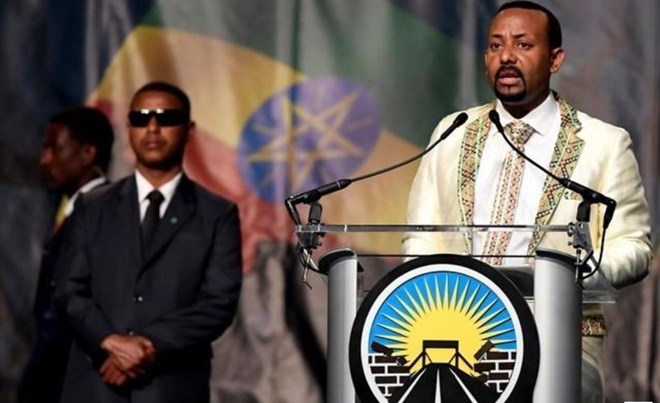
Ethnic unrest tarnishes new Ethiopian leader’s reforms

Saturday August 25, 2018

Shiburu Kutuyu, a 45-year-old Ethiopian maize and coffee farmer, was jolted awake by gunshots one night in June. He told his wife and seven children to flee.

They returned to find their mud-walled home had been burned down, but no sign of Shiburu. Eleven days later, fellow farmers found his body hanging from a tree, his severed limbs strewn on the ground.

“A mob of Oromo youths killed him in the most gruesome manner,” Shiburu’s brother-in-law Mulugeta Samuel told Reuters from one of the dozens of camps in southern Ethiopia filled with people who fled violence between two ethnic groups: the Oromo and the Gedeo.

A surge in ethnic violence, sometimes in the form of mob attacks, has displaced nearly 1 million people in the past four months in southern Ethiopia and is inflaming bad feeling between ethnic groups in other regions.

The violence threatens to undermine Prime Minister Abiy Ahmed’s calls for unity in one of Africa’s most ethnically diverse countries. It also overshadows the popular liberal measures he has announced since coming to power in April.

Some observers say young men from Abiy’s ethnic group, the Oromo, have been emboldened by his rise and are attacking other groups in revenge for years of marginalization.

Ethiopia’s security apparatus is in a state of flux since Abiy announced reform plans, said Asnake Kefale, an assistant professor of politics at Addis Ababa University. “Some individuals have taken advantage of this state of affairs,” he said.
On Thursday, Sorri Dinka, spokesman for the Oromiya Police Commission, said authorities are taking action against individuals suspected of ethnically motivated crimes.

He mentioned the so-called “qeerroo”, a term used to describe young Oromo men involved in the protest movement over the past three years that culminated in former Prime Minister Hailemariam Desalegn’s resignation.

Some people who fled their homes still feel federal government and local authorities are failing to halt violence against them.

Tihun Negatu escaped an attack on her village in June. She and her two children have been living in a school converted into a shelter, wearing the clothes they fled in.

“The government is not willing to bring them to justice,” she said of the Oromo men who chased her farming community off its land, and burned down her home and a bar she ran.

The government denies turning a blind eye. Federal disaster management chief Mitiku Kassa said a committee of ministers and regional officials has been formed to oversee rehabilitation and reconciliation efforts.

He told Reuters nearly 400 people in Oromiya have been arrested on suspicion of inciting violence between Gedeos and Oromos. “If not stopped altogether, such incidents are very dangerous for the country as they may spread,” he said.

The government has urged elders in both communities to seek reconciliation. Townhall meetings have been taking place regularly though they have not halted the violence.
Officials in camps visited by Reuters last week said about five children die every day due to illness and hunger.

Plans to return displaced populations to their home areas triggered protests this month by people who said their safety was not guaranteed.

CHANGES

One of Abiy’s boldest moves has been to loosen the grip of a state that had ruled with an iron fist. He has said security forces must be reined in, emergency rule has been lifted and thousands of political prisoners released.

Abiy, 42, rode the wave of anti-government unrest that originated in his Oromiya region. He was appointed by the ruling Ethiopian People’s Revolutionary Democratic Front (EPRDF) as it sought to ease ethnic tensions and appeal to disaffected youth.

The sweeping changes, however, have lifted the lid on historic conflicts over land, resources and local power. Underlying ethnic divides have also flared.

The Gedeo who have lived as minorities in modern-day Oromiya for generations say that although they have been subjected to violence by Oromos in the past, the worst attacks began a day after Abiy took office.

Since then, Abiy has toured Ethiopia extensively, but not visited the areas where the Gedeo and Oromo have been fighting.
He says unspecified “forces with the goal of undermining peace and unity” are to blame for the violence. But some critics say he has avoided tackling the issue head on for fear of alienating his Oromo base.

“It is difficult for the people to rely on your rhetoric unless you practically toil to bring lasting peace for all Ethiopians irrespective of their ethnic or religious background,” a diaspora group of Gedeos wrote recently in an open letter to Abiy.

In a statement this week he acknowledged the mob nature of some of the violence: “Changes have … brought mob justice, fueled by some segments of the youth in some areas, undermining rule of law.”

The prime minister, who has a doctorate in conflict resolution, has enjoyed wide support since coming to office. Stickers bearing his face are plastered on many vehicles in Addis Ababa and other cities.

“He will not want to rock that boat,” said a Western diplomat in Addis Ababa, referring to the positive response Abiy has received since taking office after three years of street protests in which security forces killed hundreds of people.

“But he risks further destabilization if he does not lay down the law.”

RISKS

The violence in southern Ethiopia is one of several ethnic-based disputes nationwide.
Tens of thousands remain displaced by violence along the border between the Oromiya and Somali regions. Oromos accuse a local Somali paramilitary force of atrocities.

This month, mobs looted properties owned by minorities in the Somali region’s capital Jijiga. The federal government said unrest had been stoked by regional officials who had fallen out with authorities in Addis Ababa.

Other incidents, though isolated, show the risks of mob retaliation.

Earlier this month a man was lynched and left hanging upside down in a public square in the Oromiya town of Shashemene by a mob who wrongly suspected he was carrying a bomb. Police stood by idly, according to an eyewitness.

In June in the southern city of Hawassa, several men from the Wolayta ethnic group were burned alive by members of the rival Sidama ethnic group. According to witnesses interviewed by Reuters, the men were targeted in a push by Sidamas to form their own region.

The violence raises questions about the structure of the state: a federal republic where regional boundaries were redrawn on ethnic lines in 1994.

Seizing power after a long guerrilla war, the EPRDF said the arrangement it would empower marginalized ethnic groups after centuries of domination by Amharas.

Critics say it has eroded national unity.

“The ethnicized nature of our politics has emphasized our differences for the last 27 years,” said opposition politician Lidetu Ayalew. “We have to find a way out of this if this country is to remain intact.”

MPs urge TSC to post more female teachers to Garissa

WEDNESDAY AUGUST 8 2018
Sophia Abdinoor and Anab Gure

Ijara MP Sophia Abdinoor (left) and Garissa Woman Rep Anab Gure at Fafi during a parents’ day at Fafi Girls Secondary School in Bura East on August 6, 2018. The leaders asked TSC to post more female teachers in the county to help solve girl’s issues. PHOTO | ABDIMALIK HAJIR | NATION MEDIA GROUP

By ABDIMALIK HAJIR
More by this Author


Two MPs from Garissa have asked the Teachers Service Commission (TSC) to post more female teachers to girls only schools so as to enable them address their issues.

Garissa Woman Rep Anab Subow and Ijara MP Sophia Abdinoor urged the government to employ more female teachers as part of affirmative action.

Speaking Monday at Fafi Girls Secondary School in Fafi Constituency during the school’s parents’ day, the two lawmakers said that for a long time, girls schools in the area have been disadvantaged because they lack enough female teachers compared to boys schools.


In Garissa County, out of the 11 girls’ schools, only four have female headteachers.


PERFORMANCE AFFECTED


Mrs Abdinoor said the current number of female teachers in girls’ schools in the region is very low, something she said is impacting negatively on the performance of the girls.

She said that at a personal level, there are issues that girls can discuss freely with female teachers as opposed to their male counterparts.

She said that very few girls’ schools in the region are led by headmistresses.

“I am appealing to the Ministry of Education to seriously look into this matter because it is one of the biggest contributors to the poor performance among the girls,” she said.

She challenged Form Four leavers joining colleges to take up teaching as a profession, noting that they are the ones who will save the region from the current problem of insufficient teachers.

The Garissa woman rep, on her part, said that for girls are more comfortable sharing their issues with female teachers.

Internet in Ethiopia’s Somali region shut down after regional violence

Wednesday August 8, 2018

Authorities have shut off Internet access in eastern Ethiopia amid an outbreak of violence there, residents said on Wednesday, a sign of the challenges facing reformist Prime Minister Abiy Ahmed in containing ethnic tensions in parts of the country.

The residents, one speaking from Oromia region and the other from the city of Harar, said the connection had been down for three days — the first time access has been cut off since parliament lifted a state of emergency in June.

Ethiopian government spokesman Ahmed Shide did not immediately respond to a phone call and a text message seeking comment on the shutdown, which was reported on Tuesday by digital rights group Access Now.

Ads By Google

Violence broke out on Saturday in Jijiga, the capital of Ethiopia’s Somali region, with mobs looting properties owned by ethnic minorities. Security officials shot dead four people, a witness told Reuters.
The government said unrest had been stoked by regional officials.

The residents in Oromia and Harar said they were concerned the violence could spread from the Somali region into other parts of eastern Ethiopia, in part because tit-for-tat ethnic reprisals were one part of the unrest that roiled the country for three years until the resignation of Prime Minister Hailemariam Desalegn in February.

The government had imposed emergency rule in February, a day after Hailemariam’s resignation after three years of street protests and violent unrest.

Since replacing Desalegn in April, Abiy has turned politics and the economy on its head in the country of 100 million people but continuing ethnic violence poses a challenge to his reform drive.

Nearly 1 million Ethiopians are currently displaced from their homes due to ethnic violence in the Somali and Oromia regions and elsewhere, according to the United Nations.
The government’s move to shut down the Internet amid the latest violence over the weekend suggests a continuation of a knee-jerk reaction to unrest in recent years.

Abiy, a 41-year-old former army officer, has pledged greater freedoms. In the four months since he took office, the government has released political prisoners and lifted a ban on opposition groups.

During the protests before Abiy took office, the government frequently switched off the Internet, sometimes for several months at a time, in Oromia, a large region that surrounds the capital Addis Ababa and extends east all the way to the Somali region.

Halting the ability of young people to organize demonstrations or strikes online or on social media, using smartphones, was a strategy used to contain protests.

Ethiopia, a country of 100 million people, is one of the few countries in the world that still has a state telecoms monopoly, which makes shutting off the internet more simple than if there were multiple telecoms providers.